A studyEmotional sobriety
Bill W.'s 1958 letter to a friend in depression, the twenty questions Tom B. of Charlotte built on it, the card Joe McF. carries, Paul M.'s road back through all Twelve Steps, and where the Book says it.
The letterThe next frontier
In January 1958 the AA Grapevine printed a letter Bill W. had written to a friend who was in a depression. Bill was twenty-three years sober. It carried the title The Next Frontier: Emotional Sobriety, and its first paragraph has this site’s name in it: “I think that many oldsters who have put our AA ‘booze cure’ to severe but successful tests still find they often lack emotional sobriety. Perhaps they will be the spearhead for the next major development in AA — the development of much more real maturity and balance (which is to say, humility) in our relations with ourselves, with our fellows, and with God.”
The letter is short, and it is a confession before it is a teaching. Bill had been depressed the autumn before for no reason he could find, and had asked himself why the Twelve Steps would not release it. He had stared at the St. Francis prayer by the hour. Then he saw what the matter was: “My basic flaw had always been dependence — almost absolute dependence — on people or circumstances to supply me with prestige, security, and the like. Failing to get these things according to my perfectionist dreams and specifications, I had fought for them. And when defeat came, so did my depression.”
The urges themselves were not strange. “Those adolescent urges that so many of us have for top approval, perfect security, and perfect romance — urges quite appropriate to age seventeen — prove to be an impossible way of life when we are at age forty-seven or fifty-seven.” What made them fatal was the second thing he found under the first: “For my dependency meant demand — a demand for the possession and control of the people and the conditions surrounding me.”
What he did about it is the rest of the letter, and the last section of this page. The letter whole is on a second sheet beside this one, The Next Frontier, with the twenty questions as a yes-or-no list and a page of work under Bill’s sentence. The sentence Tom B. built a talk on, and the one Joe McF. reads out at the start of his, is this: “If we examine every disturbance we have, great or small, we will find at the root of it some unhealthy dependency and its consequent unhealthy demand. Let us, with God’s help, continually surrender these hobbling demands.” The letter ends in the words Joe has read aloud at the start of his meeting: “I have been given a quiet place in bright sunshine.” Joe McF., 2025, 2:49
The phrase was not new to Bill in 1958. The Twelve and Twelve had used it five years earlier, in the first paragraph of its Step Twelve, and tied it to something this page comes back to: practising all the Steps.
Here we begin to practice all Twelve Steps of the program in our daily lives so that we and those about us may find emotional sobriety.
12&12 p.106 ¶1
The Big Book’s first 164 pages never say the words. Among its stories one does, the doctor’s in Acceptance Was the Answer, and it puts the thing on a scale: “How important is it compared to my serenity, my emotional sobriety?” BB p.420 ¶1
The talkTom B. of Charlotte
Tom B. of Charlotte, North Carolina (1935–2002) gave a talk called Emotional Sobriety that went round the circuit, was sold on CD and DVD, and is on the tapes here twice. The first delivery is from Little Rock in 1996, to an audience of addiction counselors, a month short of his twenty-ninth year sober. The second, about 1998, is the one that was sold as the CD, with his sponsor Bob and his friend Earl having spoken the same afternoon. Who he was depends on who is telling it. The collection that keeps the 1996 tape calls him a licensed addictions counselor who trained rehab staff; the man who introduced him in Little Rock called him a certified addictions counselor who taught at counseling schools and institutes; Joe McF. remembers “a college professor of psychology”; Tom himself, at the start of the 1996 talk, asks the room to keep in mind “that I’m a layman, not a psychiatrist, not in any sense an expert on anything.” Tom B., Little Rock, 12:20 This page records all four and reconciles none.
The talk begins where Bill’s letter did, with his own crisis. Tom was twenty-six years sober and his life was going well, and he was begging to die. At exactly the right time, he says, he came upon Bill’s letter, “and upon reading this, I found out what it was precisely and exactly that I was going through at this time.” Tom B., Little Rock, 10:47 His account of what Bill found is the letter in plain words:
Through examining his life, he discovered that he was and had been almost totally dependent on other people or groups to make him feel good about himself, almost totally dependent, to give him approval and security and prestige. And what’s more, he found that he was demanding of others that they give him these things by trying to control and possess them. In short, Bill discovered after 23 plus years of sobriety, that he was emotionally un-sober. He had become dependent on others to provide him with the feelings which should have come to him from himself as a result of his own actions.
Tom B., Little Rock, 12:20
His definition follows from that. “Emotional sobriety, loosely defined, is when what I know about myself and what I believe and feel about myself are pretty much consistent. That is, my beliefs and feelings about me match the facts about me.” Emotional unsoberness is when they do not: “when I’m emotionally un-sober, the input of others almost totally determines what I believe and how I feel about me.” Tom B., CD, 17:13
Three things he says about it set the test up. It is a stage, not a verdict: emotional unsoberness “is a stage in recovery through which those in recovery will invariably pass. You can put that in the bank. Maybe not just once either.” Tom B., CD, 20:53 It is late, and it is hidden. It comes “somewhere between four and six years” in, to a person whose life is going well, as a lingering feeling that all is not well, a dull continuous anxiety, worthlessness, and it is “often misdiagnosed, usually as depression.” Tom B., Little Rock, 19:09 Bill was twenty-three years sober when he wrote the letter; Tom was twenty-six before he was fully aware. Tom B., Little Rock, 21:44 And it runs below the surface: “it operates automatically and unconsciously, just like a tape recording.” Tom B., CD, 21:56
The testTwenty questions
Tom asks the questions as yes or no, and asks them quickly, and not only of the alcoholics: “you don’t have to be an alcoholic in recovery to be emotionally sober or un-sober.” Tom B., CD, 18:16 These are the twenty of the CD talk, in his order, which is also the order Joe McF. reads them in. At Little Rock two years earlier he asked ten of them, in a different order, and the scoring was the same: “if you answered just several of them in the affirmative, you’re probably emotionally unsober to some degree.” Tom B., Little Rock, 16:34
- Do you accept criticism well?
- Are you usually hurt or angered by criticism?
- Do you have a difficult time accepting compliments?
- Do others think more highly of you than you do of yourself?
- Do you depend on others to make you feel good about yourself?
- Does what others say about you unduly influence your feelings and beliefs about yourself?
- Do you often do a good job and know it, yet don’t feel good about it?
- Do you often feel like a loser, even though you know you’re a good person?
- Do you often put yourself down?
- Looking honestly at your life, do you treat yourself very well?
- Do you treat others better than you treat yourself?
- Do you do nice things for others in order to get attention or compliments?
- When you express love for someone, are you hurt when he or she doesn’t respond in kind?
- Do you often feel afraid, even though you know everything’s okay?
- Do you often feel you’re not enough?
- Do you often feel you’re falling short of what you should be and what you should do?
- Does it bother you a great deal when you know that someone dislikes or disapproves of you?
- Do you often refrain from doing or saying what you know you should, for fear of how others may react to it?
- Do your feelings depend on how your significant other is treating you?
- Do you feel you’re a good person no matter what others may think?
“How’d you do?” Three of the twenty run the other way, the first, the tenth and the last, where a no is the unsober answer; Tom does not say so, and his scoring is about the rest: “If you answered several of these questions and I have a feeling some of you did in the affirmative, you’re probably emotionally un-sober to some degree.” Tom B., CD, 19:38 The questions are a machine transcript of a tape, checked against a fan’s transcription of the same CD; the tape is the authority, and every link on this page opens it at the moment.
Joe McF. carries the test on a card Tom gave him, reads the first seven on Sober Speak in 2022, and calls it by a name of his own: “It’s an emotional immaturity test.” Joe McF. 33:01 His scoring line is Tom’s with that word in it, “you’re probably emotionally immature to some degree. And this is unconscious, automatic, and habitual.” Joe McF. 34:22
The syndromeDependency and demand
What a bad score points to is what Tom calls the emotional inebriety syndrome, or the dependency-demand cycle, Bill’s two words made into a wheel. “I depend on you, feelings about me, and what’s more, I try to control and manipulate you so I’ll get the responses from you that I so deeply need.” The person is looking outside for what “must come from within himself,” and the cycle “is always based on false beliefs and it’s always grounded in fear.” Tom B., Little Rock, 24:55 Its parts, as he lists them: seeking approval and emotional security from someone or something else; seeking reassurance constantly, and it is never enough; depending on another to fill all your needs; feeling like a victim and blaming others when they are not filled; trying to possess and control another to make sure they are; and doing all of it unconsciously and automatically. Tom B., Little Rock, 26:11 That last part matters to him: “If I did these things deliberately, I would be evil. But if I do them unconsciously and automatically, I’m not evil, I’m sick.” Tom B., CD, 35:04
The cycle always fails, and he says why: “if your needs are insatiable, you never get enough. So you try harder. You push people, you push them, you push them and you drive them away.” Tom B., CD, 36:22 Then he sends the room to the Book. “The Big Book, I read it one time, covers this syndrome in masterful detail. Pages 60 to 62.” The actor is Bill’s picture of the same wheel, written nineteen years before the letter:
Each person is like an actor who wants to run the whole show; is forever trying to arrange the lights, the ballet, the scenery and the rest of the players in his own way.
BB p.60 ¶8
What is his basic trouble? Is he not really a self-seeker even when trying to be kind? Is he not a victim of the delusion that he can wrest satisfaction and happiness out of this world if he only manages well?
BB p.61 ¶1
Selfishness—self-centeredness! That, we think, is the root of our troubles. Driven by a hundred forms of fear, self-delusion, self-seeking, and self-pity, we step on the toes of our fellows and they retaliate.
BB p.62 ¶1
Tom’s gloss on that page is one word: “The root, not a root.” Tom B., CD, 36:22 The commonest form of the syndrome “is usually called people pleasing,” and it has a belief and a fear: pleasing others will beget love and approval; “Not pleasing others will beget abandonment, rejection, the deepest fear of all human beings.” Tom B., CD, 37:33 Under all of it he puts one thing. “The chief barrier to emotional sobriety and what I believe to be the most malignant character defect of all. Let me call your attention to self-hate. Self-hate is reversed self-love. It’s Narcissus frowning at himself in the water.” Tom B., CD, 44:13 At Little Rock he put it personally: “if anybody else on the face of this earth had treated me as badly as I treated me, I would have killed them.” Tom B., Little Rock, 43:17
The Twelve and Twelve has the same wheel in Step Twelve, under the word security, and it reads like a second draft of the letter:
Our demand for emotional security, for our own way, had constantly thrown us into unworkable relations with other people. Though we were sometimes quite unconscious of this, the result always had been the same. Either we had tried to play God and dominate those about us, or we had insisted on being overdependent upon them.
12&12 p.115 ¶1
“We blamed them, being quite unable to see that our unreasonable demands had been the cause.” 12&12 p.115 ¶1 The Book’s name for the condition under the drinking is on its first pages: “restless, irritable and discontented.” BB p.xxviii ¶4 And its list of what we could not do before the Steps is Tom’s list of symptoms: “we couldn’t control our emotional natures, we were a prey to misery and depression” BB p.52 ¶2 — the bedevilments, which the Book says the Steps were a basic solution for.
Tim M makes one distinction worth carrying into the test. “Sobriety with alcohol means an absence of alcohol from my system. Whereas emotional sobriety cannot or should not mean an absence of emotion from my life. It must mean something else.” Tim M, Bali, 2:47 The something else, for him, is use: “It’s not so I can be comfortable, it’s so I can be useful.” Tim M, Bali, 18:09 And being all over the place is a reading, not the disease: “it’s not the problem in itself, but it’s the canary in the mine.” Tim M, Berlin, 7:49 The reverse holds too: “Just because I’m comfortable doesn’t mean I’m doing God’s will.” Tim M, Berlin, 3:41
The Steps againPaul M.'s road
Joe does not get to the test until he has said what the problem looks like from the inside of a long sobriety. “I’ve got 30 years sobriety and I’m scared. I’ve got 20 years sobriety and my wife wants me out of the house. I’ve got 10 years of sobriety and everybody’s happy, joyous and free and I go home and secretly want to commit suicide. We don’t talk about that.” Joe McF. 33:01 Just before it he has read from AA Comes of Age on the single surrender that produces sobriety and the ego that comes back unless the discipline is kept, and quoted a man his friend Sandy Beach called his favorite member of AA: “We quote Paul Martin. He’s gone now.” Joe McF. 30:13
The members there at those groups are committed to working the steps and re, this is key, reworking the steps. He said the worst advice that he ever got in AA was to work the first nine months and then attempt to exist on 10, 11 and 12. He said that nearly killed him. In 1963, 16 years sober, he heard a suggestion that there’s great benefit in redoing all of the steps.
Joe McF. 31:39
Paul M. of Riverside, Illinois, sober from August 15, 1947, wrote for the Grapevine for thirty years, and the lines Joe reads are his, nearly word for word, from a piece he wrote at sixty years sober: “The worst advice I ever got in AA was to work the first nine Steps once and then attempt to exist on Steps Ten, Eleven and Twelve. In 1963, sober sixteen years, I heard a suggestion that there’s great benefit in redoing all of the Steps. It turned out to be absolutely correct. In my experience, AAs who continue to work all of the Steps do not suffer from depression, anxiety, apathy, boredom, and similar symptoms.” (“Nearly killed him” is Joe’s.) The account of that year is an earlier piece, I’ve Done the Twelve Steps — now What?, in the Grapevine of March 1973:
“It wasn’t until sixteen years after I sobered up on the AA program that I discovered the benefits of working all the Steps, again and again. Until that time, I had rocking-chair sobriety: a great deal of motion, without going anywhere; a lot of activity, but not much action.” The mistake was the custom of the place: “In the area where I entered AA, the feeling was that you worked the first nine Steps once and from there on used only the last three Steps for the rest of your life.” So “In the first two or three years, I did as thorough a job as possible with One through Nine and then attempted to subsist on Ten, Eleven, and Twelve. In 1963, I ran into the view that there was continuing benefit in persistent work with all the Twelve Steps. On the theory that it couldn’t hurt to try, I went back to the first Steps and started over. I wrote out a new Fourth Step and followed it with another Fifth Step.” What he found is the distinction this whole study turns on: “It turned out that there was a vast difference between a periodic written inventory and a Tenth Step spot check.” He quotes Dr. Tiebout on the ego’s recuperative powers and the “repeated inventories, not just one” it takes to keep it checked, writes a new Eighth Step and finds names on it, and reports on the people he was by then working with: “A substantial percentage of the alcoholics I work with today have been sober for ten or fifteen years or more. They are in misery and struggling with painful conditions within themselves despite their long periods of sobriety. Just about 100 percent of the time, it turns out that these AAs either have not continued working all the Steps or never worked them to begin with.” And: “Invariably, when they start back at Step One and carefully work each of the succeeding Steps, they report dramatic improvements in themselves.” His summary line is the one to keep: “The program is a road, not a resting place.”
The three pieces are printed whole on a page of his own, Paul M., with the other fourteen in his lines and his thirteen talks on the tapes.
Tom says the same thing to a room that has just scored badly, and says it as a question:
These steps worked on the worst problem you’ve ever had in your life. Who is to say they won’t work on this one too, my friend? Can you surrender to your present condition and begin back at Step One?
Tom B., CD, 25:38
The Book had already said where the laurels lead. “It is easy to let up on the spiritual program of action and rest on our laurels. We are headed for trouble if we do, for alcohol is a subtle foe.” BB p.85 ¶1 The Step Ten paragraph before it says the inventory “should continue for our lifetime” BB p.84 ¶1, and the Twelve and Twelve’s sentence quoted at the top of this page says all Twelve Steps. Paul’s 1973 piece reads that sentence as a direction, not a flourish.
The way outWhat Bill did, what Tom did
Bill’s answer in the letter was to cut the dependencies and reverse the current. “Reinforced by what Grace I could secure in prayer, I found I had to exert every ounce of will and action to cut off these faulty emotional dependencies upon people, upon AA, indeed, upon any set of circumstances whatsoever.” The healing he found ran the other way from the demand: “This seems to be the primary healing circuit: an outgoing love of God’s creation and His people, by means of which we avail ourselves of His love for us.” His proof was his own first six months, when he worked with many drunks and not one got sober, and it kept him sober anyway: “My stability came out of trying to give, not out of demanding that I receive.” The Book says it as a rule for the recovered: “Helping others is the foundation stone of your recovery. A kindly act once in a while isn’t enough.” BB p.97 ¶1
The Twelve and Twelve’s Step Twelve goes on from the wheel to the same place, and names the dependency that does hold:
When we developed still more, we discovered the best possible source of emotional stability to be God Himself. We found that dependence upon His perfect justice, forgiveness, and love was healthy, and that it would work where nothing else would. If we really depended upon God, we couldn’t very well play God to our fellows nor would we feel the urge wholly to rely on human protection and care.
12&12 p.116 ¶1
Before that it says what the relations have to be put on: “a give-and-take basis,” and “we would need to give constantly of ourselves without demands for repayment.” 12&12 p.116
Tom’s list, which he says is “at least the following,” is longer and more homely, and every item of it is a Step.
-
Surrender. “First, foremost, surrender. Surrender to what? To the truth of my condition and my powerlessness over it.” Tom B., CD, 53:31 At Little Rock: “Surrender the need to control and possess. Surrender your need to demand things from other people. Stop demanding.” Tom B., Little Rock, 56:17
-
Accept yourself as you are right now. “Real acceptance, you see, stops that inner struggle. It puts you in neutral.” He borrows Carl Rogers’s curious paradox, that the moment I accept myself just as I am, then I begin to change. Tom B., CD, 58:36
-
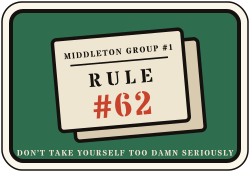
Sacrifice. “Third Step Prayer begins how? God, I offer myself to you. If that ain’t sacrifice, I ain’t never heard it.” The things to be sacrificed: “The need to control, the need to possess, the need to understand, the need to always be right, the need to be comfortable.” Tom B., CD, 1:02:15 And the self-importance: “Rule number 62, don’t take yourself too damn seriously.” Tom B., CD, 1:02:52 The prayer he means is on p.63: “God, I offer myself to Thee—to build with me and to do with me as Thou wilt. Relieve me of the bondage of self, that I may better do Thy will.” BB p.63 ¶2 The rule is on a card in the Twelve and Twelve: “Don’t take yourself too damn seriously.” 12&12 p.149 ¶1
-
Believe. “Got to believe that with help you can and will become emotionally sober. Beliefs are powerful.” Tom B., CD, 1:02:52 The Book is blunter about the help: “Neither could we reduce our self-centeredness much by wishing or trying on our own power. We had to have God’s help.” BB p.62 ¶2
-
Pray for it to be removed. “Ask God to help you change, to remove your fear, your false beliefs, your self-hate, help you accept and forgive yourself. Or if you want to make the prayer real simple, just say, God, Thy will be done.” Tom B., CD, 1:05:59 He quotes the page he is standing on: “We are sure God wants us to be happy, joyous, and free.” BB p.133 On forgiving yourself: “To forgive literally means to cease to resent, to give up the need for revenge or retaliation.” Tom B., Little Rock, 1:02:44
-
Tell somebody, and let them watch. “Talk with somebody else about what you’ve found.” Tom B., CD, 1:05:59 The reasons: “First, to get it out of my system. Second, to ask this person to help me watch for these patterns. It gives me an extra set of eyes.” Tom B., Little Rock, 1:00:04
-
Watch, and put a new message over the old. “Watching is an ancient and honored spiritual tradition. It means wake up. Observe yourself.” Tom B., Little Rock, 1:02:44 The old tape cannot be erased, only caught: “The only way, the only way to change those old messages is to watch for them, and when they start to play, Stop them immediately” Tom B., Little Rock, 1:03:58. “If you put a new message over the old message long enough, the new message becomes the only message.” And: “Watch for the good things you do.” Tom B., CD, 1:08:32 This is Step Ten, and Tom says so, reading p.84 to the room. The Book’s version:
Continue to watch for selfishness, dishonesty, resentment, and fear. When these crop up, we ask God at once to remove them. We discuss them with someone immediately and make amends quickly if we have harmed anyone. Then we resolutely turn our thoughts to someone we can help. Love and tolerance of others is our code.
BB p.84 ¶1
- Give what you want and need. “Give to others what you want and need. Love others unconditionally. It’s hard stuff, ain’t it? Give without expectation. Give anonymously.” Tom B., CD, 1:10:36 At Little Rock: “Give away exactly what it is that you want and need. And give without any expectation of any return.” Tom B., Little Rock, 1:06:55 This is the letter’s Twelfth Stepper of six months, who smiles and turns to the next case, and the last thing Tom says before he sits down: “this is a giving life, and it’s only through giving that I may receive.” Tom B., CD, 1:11:52 His own last example is a tired woman at a ticket counter that afternoon, and what he told her: “you either can hate that man for the rest of the day or you can pray for him every time you think of him. Your choice.” Tom B., CD, 1:12:57
Joe McF. makes Step Ten the instrument, at a meeting on emotional sobriety and the Tenth Step: a diagram for living on which the line is not to go “too high, too low, too fast, too slow” Joe McF., 2025, 10:54, and the truth is “somewhere in the middle, not too high, not too low, not too fast, not too slow.” The Step’s own wording is the reminder: “It doesn’t say if you were wrong, it says when you were wrong.” Joe McF., 2025, 21:45 And the word Bill used for the fear at the root of every disturbance is the one the Book brackets beside every name on the inventory: “This short word somehow touches about every aspect of our lives. It was an evil and corroding thread; the fabric of our existence was shot through with it.” BB p.67 ¶3
Sources
- Bill W., “The Next Frontier: Emotional Sobriety”, AA Grapevine, January 1958. Reprinted in the Grapevine’s Emotional Sobriety: The Next Frontier (https://store.aagrapevine.org/emotional-sobriety-the-next-frontier-soft-cover), and on silkworth.net (https://silkworth.net/alcoholics-anonymous/the-next-frontier-emotional-sobriety/). The letter is the Grapevine’s; this page quotes it, and the sheet beside it carries it whole, the Grapevine’s copyright on its foot.
- Tom B., Charlotte, NC, Emotional Sobriety, Little Rock, 1996 (the tape, 0:00), from Stories of Recovery (https://storiesofrecovery.org/collections2.htm); and the CD talk, c. 1998 (the tape, 0:00), from the Mad Dog Recovery AA Speakers podcast (https://podcast.maddogspeakers.com/e/tom-b-emotional-sobriety/). A fan’s transcription of the CD talk, Emotional Sobriety and Food, 2016 (https://emotionalsobrietyandfood.com/2016/03/14/link-to-tom-brady-on-emotional-sobriety-mp3-and-pdf/), was used to check the questions.
- Joe McF., Sober Speak 262, The Dark Side of Spiritual Growth, 2022 (the test, 33:01); and a Big Book Awakening meeting on emotional sobriety and Step Ten, 2025 (the letter read, 2:49).
- Paul M., Riverside, Illinois: “I’ve Done the Twelve Steps — now What?”, AA Grapevine, March 1973 (Vol. 29 No. 10); “It Works For Me”, AA Grapevine, September 2007 (Vol. 64 No. 4); “A Time-tested Program of Recovery”, AA Grapevine, October 1981. Collected with his other Grapevine pieces at https://justloveaudio.com/resources/Assorted/Paul_Martin_AA_Grapevine_Articles/, where a post on his death (87 years old, 62 years sober) names his sponsor as Tom Powers.
- Tim M, Bali International AA Round-Up 2024, Emotional Sobriety (the tape, 2:47); Friendly Circle Berlin, How not to be upset, 2022 (the tape, 3:41).
- Alcoholics Anonymous, Fourth Edition, pp.60–63, 67, 84–85, 97, 133, 420; Twelve Steps and Twelve Traditions, pp.106, 115–116, 149. Every citation opens the page beside the words.